
Shorinjii Kempo Benjamin Mee
Don’t just sit there …
Benjamin Mee has tried more exercise regimes than most, but Shorinji Kempo is his favourite. He explains why.
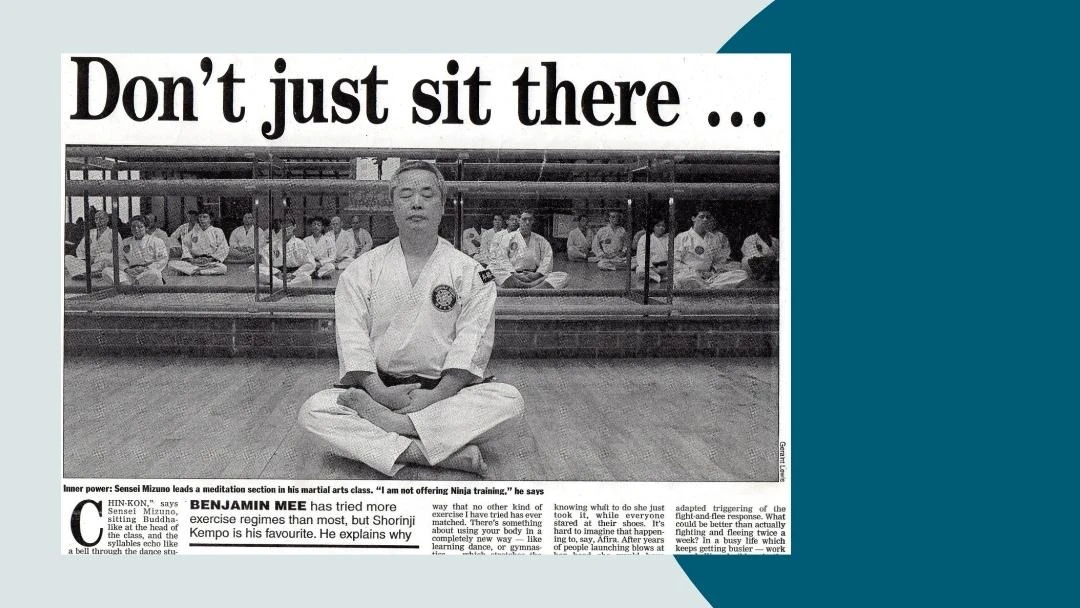
“CHIN-KON,” says Sensei Mizuno, sitting Buddha-like at the head of the class, and the syllables echo like a bell through the dance studio, signalling the beginning of a period of intense calm.
Chinkon literally means “calm spirit”, and it is a period of about five minutes in the middle of a lesson where we practise Zazen meditation, sitting in neat rows, concentrating on our breathing. When I came back to studying Shorinji Kempo—a relatively obscure martial art in the UK, but with more than 1.5 million practitioners in Japan—four years ago at the age of 32, I never thought that Chinkon might become one of my favourite parts of the lesson.
“I think it’s because we’re getting old,” says Afira, later. Afira is a lithe second-dan black belt who amazed me the other day by revealing that one of her children was 20 years old. Afira could throw you to the floor and pin you in an excruciating lock before you could say, “Doesn’t that make you old enough to be a grandm…”
But she’s right. “Five minutes of Zazen meditation could have similar benefit, maybe, to one hour of sitting about,” Sensei Mizuno said recently in the short philosophy lecture which always follows Chinkon. Mizuno is a seventh-dan master of Shorinji Kempo, and when he speaks people listen.
Because there were several newcomers to the class he went over some of the basic philosophy of Shorinji Kempo. “What place is there for martial arts in the modern world when people have access to guns? No matter how well you are trained you cannot defend against a gun. I am not offering Ninja training. There are many classes for that,” he says.
“I offer a very orthodox martial art which aims to create healthy, balanced individuals. Which is why we try to develop the mind and the body together. This is the unity of Ken and Zen, body and spirit. You can’t develop one part without the other.”
With that we get back to doing a bit of the Ken side, learning new throwing techniques. The format of the lesson is always the same: warm-up, practise kicking and punching, pair-form practice—perhaps with a few minutes sparring—then Chinkon, philosophy and Juho, or throws. And after four years of practice maybe I am more balanced—I’m certainly more flexible.
I went back to Kempo after an eight-year lay-off because an old shoulder injury flared up and paralysed a small muscle in my back.
A consultant suggested grafting half of my pectoral muscle to replace it, which wasn’t what I wanted to hear, but I remembered that Kempo involved a lot of deep stretching. And it worked. The consultant now says he has never seen such an improvement in mobility in someone with my condition.
And the other thing about Shorinji Kempo, of course, is that it feels fantastic. After a class you are energised in a way that no other kind of exercise I have tried has ever matched.
There’s something about using your body in a completely new way—like learning dance, or gymnastics—which stretches the limits of what it can achieve and seems to make the whole thing run more smoothly. Now, on the wrong side of 35, I can touch my toes without my back hurting—something I couldn’t do at 19.
And, of course, there is the self-defence application of Kempo. Recently a friend of mine, Sue, was punched in the face while strap-hanging on the Victoria Line. Not knowing what to do she just took it, while everyone stared at their shoes. It’s hard to imagine that happening to, say, Afira. After years of people launching blows at her head she would have been able to read the signs, harness the rush of adrenaline and execute a precise and devastating counter-attack.
Shorinji Kempo is without doubt the single most beneficial thing that I have ever tried—and as a health writer, I’ve tried plenty of different forms of exercise over the past eight years.
And it eats stress. Think about it. Stress is a mal-adapted triggering of the fight-and-flee response. What could be better than actually fighting and fleeing twice a week? In a busy life which keeps getting busier—work snowballing, builders in the flat, and, oh, we’re having a baby next month—I was actually pleased to be informed last week that I should begin preparations for my black-belt examination in three weeks’ time. It means more classes and more opportunities to hear the sound “Chin-kon.”
For more information about Shorinji Kempo visit bskf.org
First Published: Health & Fitness (Evening Standard)
Tuesday, 30 January 2001

Author: Benjamin Mee